Betting on a person's death
The Pale HorseBetting on a person's death is the financial fiction at the center of C.R. Bradley's arrangement: a client appears to wager on whether someone will die by a specified date, while the organization works to make that death occur. The bet makes a murder commission sound like a transaction between people with opposing predictions. Its apparent legality and the occult performance at The Pale Horse help conceal the practical mechanism: a chain of ordinary-looking actions culminating in the substitution of poison for a product the intended victim already uses.
The wager as a legal and moral disguise
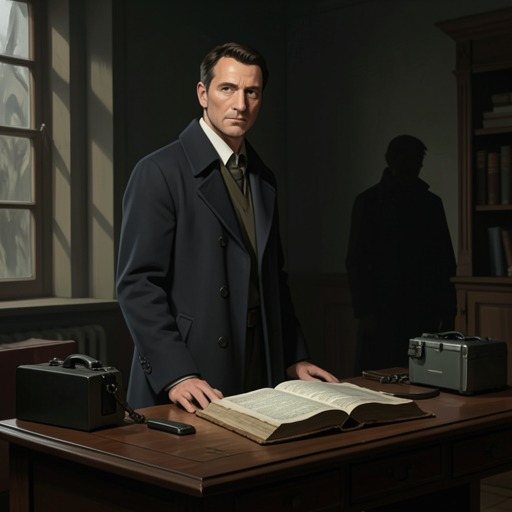
C.R. Bradley presents himself as a betting man and stresses that he is a lawyer, though disbarred. He assures Mark Easterbrook that his recommendations are legal and aboveboard, casting the service as a wager on an uncertain future rather than a commission to kill. A person might bet on the weather or on another person's longevity, Bradley argues; the client's stake is framed as a judgment about what will happen, not a payment for making it happen.
Bradley extends this argument to the supposed supernatural role of Thyrza Grey. He maintains that a confession to killing by remote control or willpower would be dismissed in court as impossible, and contrasts it with hiring someone to commit an ordinary physical assault, which could implicate the person who arranged it. The point is not established as a reliable statement of law: it is Bradley's sales pitch, designed to reassure a prospective client that the occult story makes the operation legally untouchable. Mark recognizes the calculation behind it even as he resists Bradley's account. The wager does not remove the intention to cause a death; it gives that intention a respectable-sounding description.
Terms, dates, and incentives
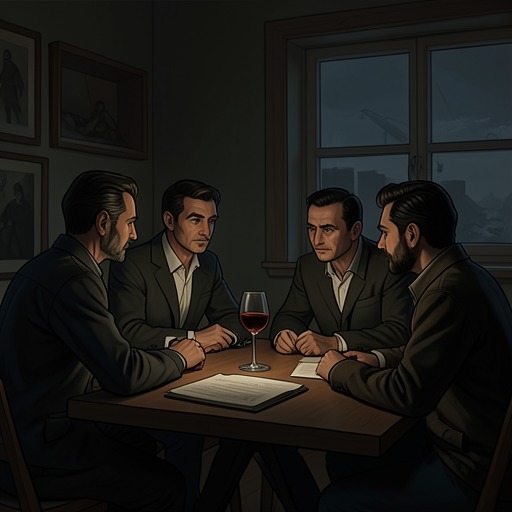
Bradley's hypothetical example turns on an interested person's desire to know when an elderly relative will die, perhaps because an inheritance could affect financial plans. He proposes reversing the apparent direction of the bet: instead of wagering that the relative will die, the client bets that she will remain alive, while Bradley bets that she will not. A written contract records the disagreement, and Bradley names a date with a two-week margin for the funeral. If the client is wrong, the money is owed to Bradley; if Bradley is wrong, he must pay.
The terms vary according to the sum at stake and, in some cases, the client's available funds. Bradley says he does not generally take poor clients except in the kind of inheritance-based case he has described. The usual odds, he claims, are five hundred to one; he illustrates this as a wager of five thousand pounds against one hundred. The odds make the transaction appear to reflect the difficulty of predicting a death within a narrow window, while also establishing the scale of the financial incentive. When Mark poses as a prospective client, Bradley proposes odds of fifteen hundred to one on a woman's death by Christmas. Mark insists that the date must be sooner, acting as though the matter is urgent. The exchange shows how the format lets a client express a desire for a death through the language of timing, prediction, and money.
From the client's visit to the poisoning
The revealed process begins with a visit to Bradley's Birmingham office. He arranges the financial side and makes the bet: he is generally pessimistic about the target's chances, while the client is cast as the more hopeful party. When Bradley wins, the client is expected to pay promptly, with an unpleasant consequence threatened for failure. The transaction is therefore not merely a theatrical pretext; it creates a financial obligation backed by pressure.
The client then visits The Pale Horse, where Thyrza Grey and her associates stage a display intended to impress him. The performance supplies an occult explanation for the promised death and makes Bradley's wager seem connected to powers beyond ordinary reach. Yet the investigation ultimately identifies poison, not supernatural force, as the essential cause. Mark describes Thyrza as the public ruling spirit of The Pale Horse, while explaining to Divisional Detective-Inspector Lejeune that the real organizer works behind the scenes. Bradley handles the financial and legal arrangements; Thyrza is paid for her role, but does not constitute the hidden operation's central intelligence.
A consumer questionnaire provides another link in the chain. Bona fide employees of consumer-research concerns canvass a particular neighborhood and ask residents about familiar products, including bread, cosmetics, tonics, sedatives, and indigestion remedies. The inquiries reveal what a potential victim habitually uses. The evidence does not establish that these survey workers know the deadly purpose of the information they collect; their genuine research work serves as an unremarkable way to gather it.
The organizer then makes the scheme's one personal intervention. Disguised as someone with a plausible reason to enter a home—a porter, meter reader, plumber, electrician, or other workman—he carries credentials that appear proper if anyone asks to see them. Under cover of an ordinary task, he substitutes a preparation for a similar household product already used by the victim. The change may go unnoticed at first. When illness follows days later, the familiar product is unlikely to be suspected, and a doctor may have no reason to connect it with deliberate poisoning. This mundane substitution is the crucial contrast to the elaborate occult show: the ritual attracts attention to an impossible explanation while the effective act passes as routine access to the home.
Compartmentalization and significance
The arrangement depends on divided knowledge. Bradley conducts the wager and legal-financial business, and the prospective client sees the performance at The Pale Horse, but these roles do not expose the hidden method. The survey workers gather information through legitimate employment; the disguised operative uses it to identify a suitable product and reach the victim. Mark's account to Lejeune emphasizes that Bradley does not know what occurs elsewhere, while the head of the organization alone knows what the head personally does. Each participant's limited view makes it harder for any one of them to disclose the whole process.
The death-betting arrangement thus joins commercial calculation to deliberate concealment. A death becomes a date in a contract, a set of odds, and a debt to be collected; the client's interest is disguised as a prediction, and the killing itself is displaced from the visible wager into an ordinary domestic routine. Bradley's confident claim that everything is simply a bet depends on separating the language of the transaction from its consequences. The plot's reversal is that the supposedly supernatural certainty of The Pale Horse is sustained by an organization whose decisive method is practical, concealed, and human.